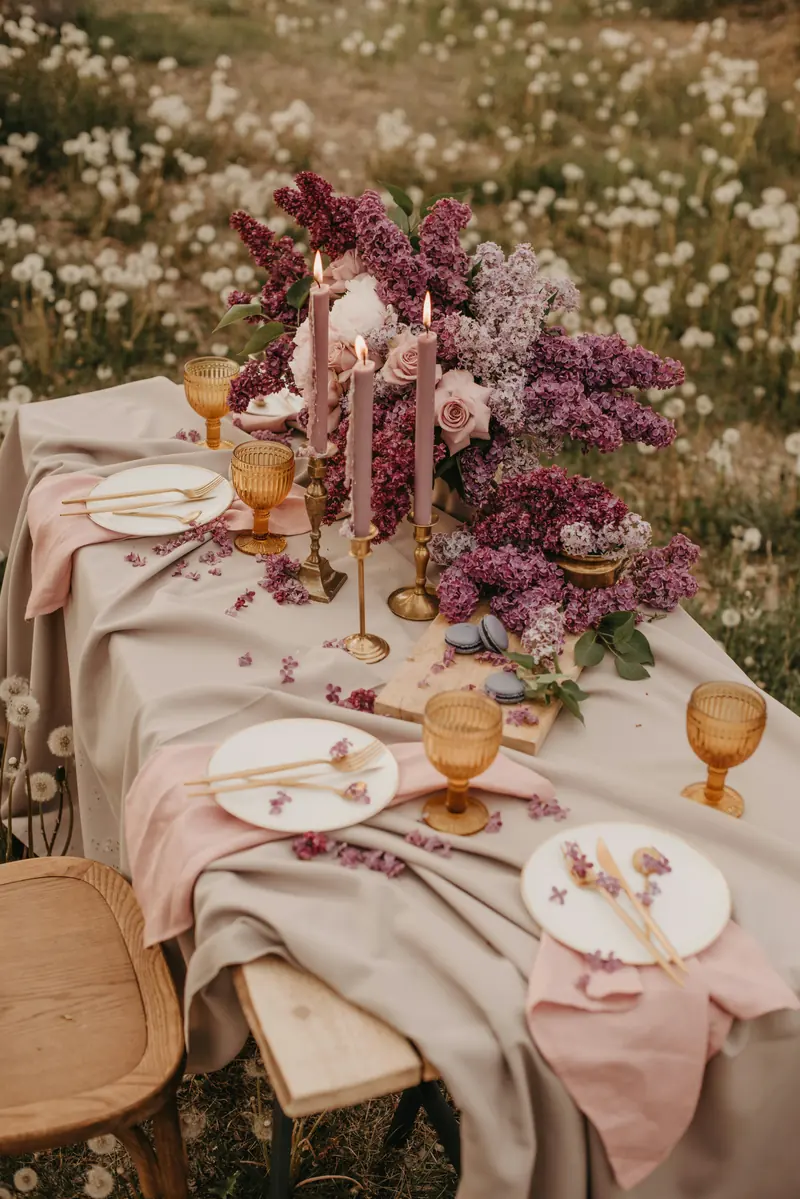
Here is what actually changes.
Fifty guests does not cost half of a hundred. It costs about seventy percent, and nobody warns you.
Per head goes up, not down
The intuition is that a smaller wedding is a cheaper wedding, and the total is. The per-guest number usually rises, and understanding why is the whole of small-wedding budgeting.
Fixed costs do not shrink with your list. The photographer works the same eight hours for 40 people as for 170. The band plays the same four sets. The flowers on the ceremony arch cost what they cost. Divide a fixed cost across a quarter of the guests and it is four times the per-head.
Venue minimums are worse. A ballroom sold against a food-and-beverage minimum is quoting you a fixed number, so at 40 guests that minimum can imply a per-head two or three times the menu price, you are paying for food nobody eats. The per-head arithmetic and how to build one.
This is not an argument against a small wedding. It is an argument against comparing your budget to the county averages, which describe a completely different purchase.
The venue categories that work, and the ones that fight you
Restaurants and private dining rooms are the strongest option under about 50 and almost nobody lists them. You get a real kitchen, a room with a character somebody chose, no room-flip labor and no minimum designed for 200 covers. Ask whether the room is genuinely private or curtained off, and ask what the restaurant's own Saturday service does to your timeline.
Historic houses suit small numbers better than large ones, because the period rooms that seat sixty are a constraint at 171 and a feature at 40. You may get the actual drawing room rather than a tent on the lawn. What a historic house restricts.
Hotels are the hardest fit, because the minimum is the mechanism and the minimum does not care about your guest count. Some run a smaller private room with a proportionate minimum. Ask specifically for it rather than for the ballroom. How hotel minimums work.
Catering halls are built for volume and priced for it, and a 40-person wedding in a 220-person room feels exactly as you would expect. Some halls have a genuine small room. Most will offer you a partitioned corner of a large one, which is not the same thing.
Barns and estates on raw space rarely make sense small, because the infrastructure cost, tent, power, restrooms, generator, is close to fixed no matter how many chairs are under the canvas. The line items.
The clerk's office is a real option
A ceremony at a town or city clerk's office costs the $40 license and nothing else, and it is a genuine wedding rather than a placeholder. Plenty of couples marry at a clerk's office and hold a dinner afterwards, which converts the entire budget from a wedding into a very good meal for the people who matter most.
You may apply to any town or city clerk in New York State regardless of where you marry (NYS Department of Health, Publication 4210), and Westchester's six cities and 16 towns (Westchester County) give you 22 offices to choose between. The full license rules, including the 24-hour wait and the 60-day window.
Where the money goes instead
With 40 guests, the things that scale with headcount stop dominating the budget, and the things that do not scale become the wedding.
Food quality per plate can rise substantially for less money than you would expect, because you are buying 40 covers rather than 170. So can the wine. So can the room, since venues that are unreachable at 171 guests are sometimes entirely reachable at 40.
The trade is that guest experience becomes visible in a way it is not at a large wedding. At 170 people nobody notices the service ratio. At 40 they notice everything, which is the argument for spending on staff rather than on scale.
What to ask that nobody else asks
Is there a minimum, and what per-head does it imply at my count? Do this arithmetic in the room, out loud.
What is the smallest room, and is it actually private? A partition is not a room.
What is the service ratio at my count? Small weddings are where venues quietly cut staff, and it is the one thing your guests will remember.
What does the fee structure look like at this size? The administrative fee is a percentage, so it scales, but the tax treatment does not change, and a percentage of a small bill is still a percentage you should see broken out. Why that fee is not a tip.
Half of Westchester couples spend under the county median, and a good share of them are not having small weddings, they are having large ones on tight budgets. If that is you, the cost page is the one to read, and the tour checklist is the one to print.